


KEI brings over 25 years of Compound-Specific Isotope Analysis (CSIA) expertise to contaminated site assessment and remediation. Founded by Dr. Kuder, former director of the CSIA laboratory at the University of Oklahoma, KEI continues that research legacy as an independent commercial lab.

What we do
Our in-house laboratory services center on CSIA of environmental VOC contaminants, such as halocarbons, MtBE and BTEX compounds. We also offer isotope analysis of natural gas and crude oil components.
In addition to laboratory services, we offer expert interpretation of environmental CSIA data. We can assist you with help to plan the project to maximize the information potential of the isotope data.
Our client portfolio includes environmental remediation professionals, environmental forensics consultants, hydrocarbon exploration firms and federal and state government organization in the US and abroad.

What is Compound-Specific Isotope Analysis?
CSIA measures the isotope signatures of individual chemical compounds in samples, using a combination of gas chromatography and mass spectrometry. Environmental samples (water, soil gas) are analyzed using custom integrations of sample introduction peripherals such as purge and trap and thermal desorption.
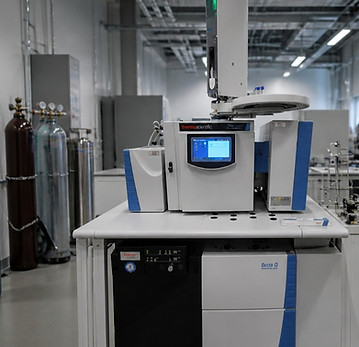

How CSIA Works?


Degradation Assesssment
When to use CSIA?
1. Assessing contaminant degradation.
An increase in the ratio of heavy to light isotopes (e.g., ¹³C to ¹²C) in a contaminant like benzene is direct evidence that degradation has occurred. This happens because molecules containing heavier isotopes — ¹³C or deuterium — tend to resist biodegradation and abiotic degradation slightly more than their lighter counterparts, a phenomenon called isotope fractionation. As degradation proceeds, the remaining contaminant becomes progressively enriched in the heavier isotope. CSIA measures this shift directly, providing a reliable line of evidence for Monitored Natural Attenuation (MNA) and for evaluating active in-situ treatments — helping consultants and regulators confirm that a remedy is working without relying solely on concentration trends.
2. Assessing contaminant sources.
Isotope composition of a spilled chemical reflects its manufacturing process and synthetic feedstocks, because different feedstocks and synthesis routes leave subtly different isotope signatures on the final product. This creates a distinct isotope "fingerprint" for each source, allowing samples of the same contaminant to be compared and matched, or ruled out, as coming from the same origin. This makes CSIA a valuable tool for allocating remediation liability among responsible parties.


Environmental Forensics


CSM Development
3. CSIA assists in Conceptual Site Model development and refinement.
Because CSIA can inform both on degradation and contaminant source, the two applications above also make CSIA a valuable input to a site's Conceptual Site Model (CSM) — the working picture of contaminant sources, pathways, and behavior that guides investigation and remediation decisions. Early in a site assessment, CSIA data can flag which areas show active degradation and which are linked to specific discrete sources, often before years of concentration-trend monitoring would reveal the same patterns. This lets consultants refine or redirect an investigation earlier, potentially reducing the monitoring time and cost needed to reach a defensible conclusion. While most commonly applied to groundwater contaminants, CSIA is equally informative for vapor intrusion assessment.
Work with us
Have a project in mind? Contact us to discuss your CSIA analysis needs.